끝나다, 끝내다 and 마치다
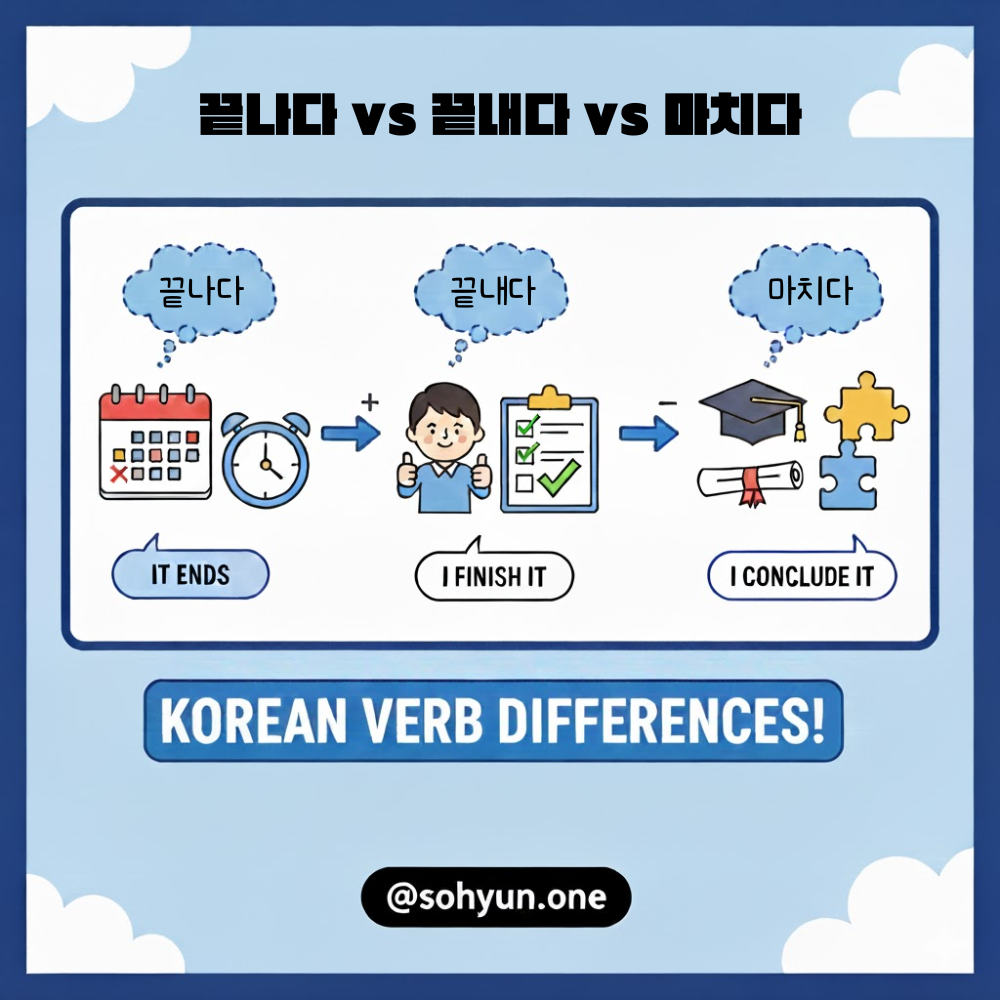
Ø How are they different “끝나다, 끝내다 and 마치다”?
🟦 1. 끝나다 — intransitive: “to end / to be over”
The subject ends by itself.
English equivalent: something ends.
✔️ Key idea
The event naturally comes to an end.
Often used for events, shows, classes, meetings, situations, feelings, etc.
✔️ Examples
영화가 끝났어요.
The movie ended.회의가 아직 안 끝났어요.
The meeting is not over yet.방학이 벌써 끝났어?
Is vacation already over?장마가 이제 끝날 것 같아요.
I think the monsoon is about to end.
🟩 2. 끝내다 — transitive: “to finish something”
Someone finishes something.
There must be an agent (a person or group) who does the action.
English equivalent: to finish / complete (something).
✔️ Key idea
It means SUBJECT actively finish something.
Always has an object (what SUBJECT finished).
✔️ Examples
숙제를 다 끝냈어요.
I finished my homework.드라마 정주행을 하루 만에 끝냈어요.
I finished binge-watching the drama in one day.이 프로젝트를 이번 주 안에 끝낼 수 있어요?
Can you finish this project within this week?청소 다 끝냈어?
Did you finish cleaning?결국 일을 제시간에 끝냈다.
I managed to finish the task on time.
🟧 3. 마치다 — “to finish/end (something)”
Transitive, like 끝내다, but slightly more formal and often used for events, processes, official activities.
Also very natural with ~으로/로 마치다 (“to end something with … / to conclude with …”).
✔️ Key idea
Similar to 끝내다, but feels more purposeful and formal/polite.
Often used in speeches, announcements, ceremonies, meetings, schedules.
✔️ Examples
🔹 Basic “finish something”
수업을 일찍 마쳤어요.
I finished class early.오늘 업무는 여기서 마치겠습니다.
We will finish the work here for today. (formal nuance)녹음을 성공적으로 마쳤습니다.
We successfully finished recording.
🔹 ~으로/로 마치다
Used to mean “to end with / to conclude with”.
오늘 수업은 이것으로 마칠게요.
We’ll end today’s class here.회의를 박수로 마쳤어요.
We concluded the meeting with applause.발표는 질의응답 시간으로 마치겠습니다.
I’ll conclude the presentation with a Q&A session.
🟪 4. Quick Comparison Table
Expression
Transitivity
Main Meaning
Typical Use
Example
끝나다
Intransitive
Something ends by itself
Events, shows, natural endings
영화가 끝났어요.
끝내다
Transitive
You finish something
Tasks, homework, projects
숙제를 끝냈어요.
마치다
Transitive
Finish/conclude (often formal)
Classes, meetings, events
회의를 박수로 마쳤어요.
