혼란스럽다, 헷갈리다, 혼동하다& 혼동되다, 어리둥절하다, 당황하다 & 착각하다
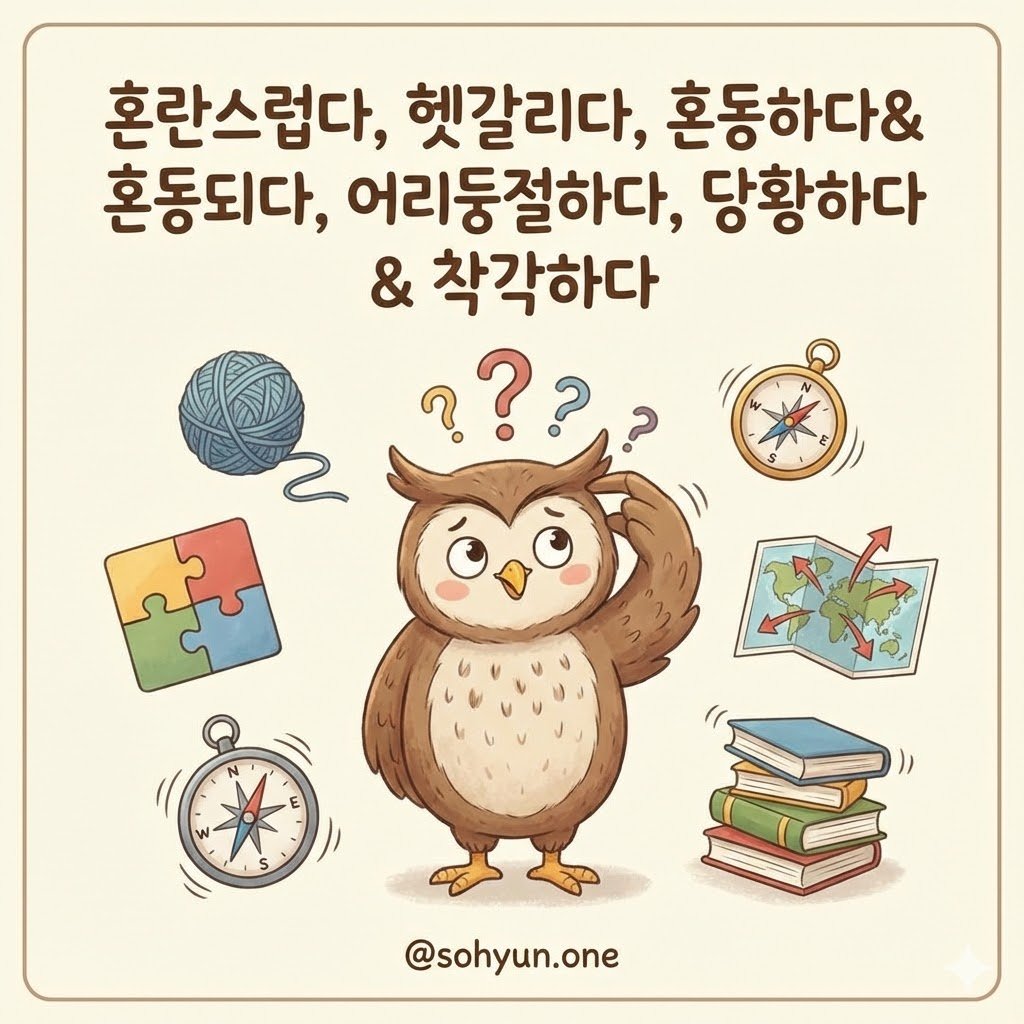
Ø How are they different “혼란스럽다, 헷갈리다, 혼동하다& 혼동되다, 어리둥절하다, 당황하다 & 착각하다”?
This 6 expressions translated to “confuse, confused, confusing” many times, but there are slightly differently used. Here are some explanations for it. However, in real life, Korean native speakers often confuse how to use them or use them differently, so it would be good to understand when each word is used and try to write accordingly.
1) 혼란스럽다
Meaning:
Used when a situation or someone’s mind feels chaotic, overwhelmed, or disoriented due to too many things happening or too much information. More formal than “헷갈리다.”
Examples
정책이 자주 바뀌어서 주민들이 혼란스러워요.
→ The residents feel overwhelmed because policies keep changing frequently.수능 영어 시험 43번 문제 때문에 학생들이 매우 혼란스러웠다.
→ Students were very confused because of the 43rd question in the Korean SAT English test.경제 상황이 불투명해 시장이 혼란스럽다.
→ The market is in a chaotic state due to unclear economic conditions.
2) 헷갈리다
Meaning:
Casual everyday expression meaning to mix things up, get things wrong, confuse similar items.
It’s about memory mistakes or similarities between things.
Examples
두 고양이가 너무 비슷해서 계속 헷갈려요.
→ The two cats are so similar that I keep mixing them up.오른쪽과 왼쪽을 헷갈려서 길을 잘못 들었어요.
→ I confused right and left and took the wrong turn.캘리포니아 시간대를 헷갈려서 Zoom 회의에 늦었어요.
→ I mixed up the California time zones and ended up being late for the Zoom meeting.
3) 혼동하다/혼동되다
Meaning:
A more formal verb meaning to confuse two concepts, facts, or items.
Used in academic, logical, or official contexts.
혼동하다 = to confuse
혼동되다 = to be confused (passive)
Examples
두 용어를 혼동하면 연구 결과가 왜곡될 수 있다.
→ Confusing the two terms can distort research results.'자유'와 '방종'을 혼동해서는 안 된다.
→ You must not conflate “liberty” and “license”.이 조항은 다른 법과 혼동되기 쉽다.
→ This clause is easily confused with another law.
4) 어리둥절하다
Meaning:
Describes a sudden feeling of bewilderment, puzzlement, or being taken aback by an unexpected event.
More like “blinking in surprise” or “being puzzled and unsure.”
Examples
갑자기 무대 조명 불이 꺼져서 어리둥절했어요.
→ I was bewildered when the stage lights suddenly went out.그의 말에 모든 사람이 어리둥절했어요.
→ Everyone became puzzled by what he said.소현 씨의 고양이 별이가 어리둥절한 표정을 지었어요.
→ Byeol, who is Sohyun’s kitty looked bewildered.
5) 당황하다
Meaning:
To be flustered, embarrassed, panicked, or unsure how to react in a sudden situation.
Includes a social/emotional reaction (blushing, hesitating, freezing).
Examples
공격적인 질문에 당황했어요.
→ I was so flustered by the offensive question.실수를 지적 받아서 당황했어요.
→ I became embarrassed and flustered when my mistake was pointed out.리허설 중에 목소리가 안 나와서 당황했어요.
→ I was flustered because my voice didn't come out during the rehearsal.
6) 착각하다
Meaning:
To mistakenly believe something, due to a wrong assumption or misperception.
Often translates to “I thought ~~ but I was wrong.”
Examples
공연 시간이 오후 6시인 줄 착각해서 서둘렀어요.
→ I wrongly thought the performance time was 6PM so I rushed.그 강아지가 동동인 줄 착각했는데 전혀 다른 강아지였어요.
→ I mistook the puppy for DONGDONG, but he was a completely different puppy.그 소문을 사실로 착각하면 안 돼요.
→ You shouldn’t mistake that rumor for the truth.
🧭 Quick “Which One Should I Use?” Guide
If you want to say…
Use
Why
“There’s too much going on. My brain is overloaded.”
혼란스럽다
Describes chaos and overwhelming situations
“I mixed them up.”
헷갈리다
Everyday mix-ups (names, numbers, roads)
“I confused the concepts.”
혼동하다
Logical / academic confusion
“I froze because I didn’t expect it.”
어리둥절하다
Sudden bewilderment
“I panicked / got flustered.”
당황하다
Emotional reaction,a embarrassment included
“I thought it was A, but it was B.”
착각하다
Wrong assumption or misbelief
