후에 vs 뒤에 vs 다음에
How are they different “후에, 뒤에 and 다음에”?
📌 1) 후에
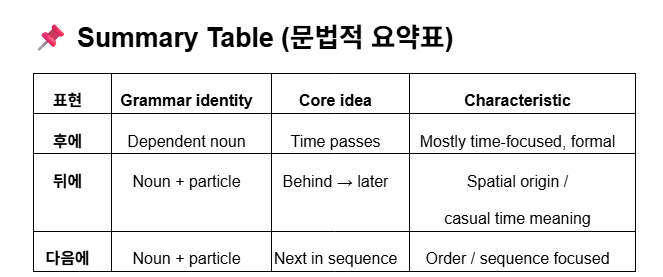
Grammar type: Dependent noun (의존 명사)
Core meaning: Indicates the passage of time after an event or time point.
Usage note: Works naturally with time nouns, numbers, or specific events.
Examples:
30분 후에 뵙겠습니다! : See you in 30 minutes!
수업 후에 도서관에 갈 거예요. : I’m going to the library after the class.
회의가 끝난 후에 QnA 시간이 있습니다. : There is a QnA session after the meeting.
Key point: Focuses on elapsed time; more formal/neutral than “뒤에.”
📌 2) 뒤에
Grammar type: Noun + particle (명사 + 에)
Core meaning: Originally a spatial noun (“behind”), but extended to mean “after” in time.
Usage note: More casual than “후에”; can refer to near future (“a bit later”).
Examples:
집 뒤에 나무가 있어요. (spatial) : There is a tree behind the house
조금 뒤에 소현이에게 전화할 거야. : I’m gonna call Sohyun later
비가 온 뒤에 무지개가 떴어요. : There was a rainbow after it rained.
Key point: Fundamentally a spatial term, secondarily temporal; less formal than “후에.”
📌 3) 다음에
Grammar type: Noun + particle (명사 + 에)
Core meaning: Emphasizes sequence or the next step, not the amount of time that has passed.
Usage note: Can mean “next time” or “after this step.”
Examples:
아침 먹은 다음에 이를 닦아요. : I brush my tooth after eating breakfast.
다음에 보자! : See you later!
회장님의 축사 다음에 회의를 진행합니다. : The meeting will be held after the chairman's congratulatory speech.
Key point: Indicates order rather than time duration.