(으)로 vs (으)러 vs (으)려고
How are they different “(으)로, (으)러 and (으)려고”?
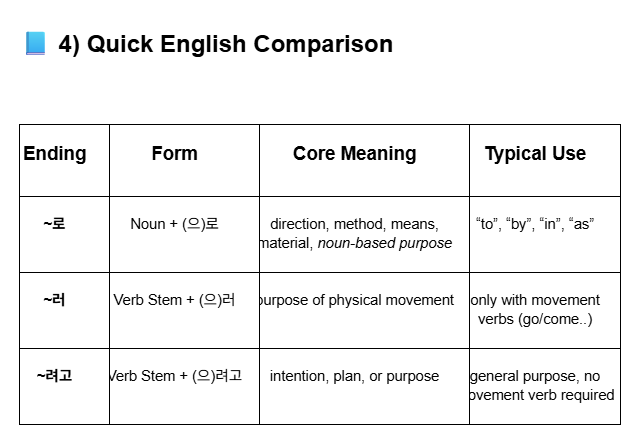
📘 1) ~(으)로 [ ~(eu)ro ] — direction, means, method, material, Purpose, or role
Meaning
“~로” mainly indicates where something is headed, how something is done, what materials are used, or what role or purpose something has.
When used to show purpose, it must follow a noun, not a verb.
Form
Noun + 로
- Noun ending in Vowel or ㄹ Batchim + 로
- Noun ending in Batchim except for ㄹ + 으로
Key Uses
Direction: toward a place
Means: by bus, by taxi
Method: in Korean, in English
Material: made of wood, made of silver
Purpose (noun only): for a gift, for lunch
Role: as a nurse, as a contents creator
Examples
내일 집으로 가요. = I go to home tomorrow.
시청까지 지하철로 갈 수 있어요. = You can go to the city hall by subway.
한국어로 말해요. = Let’s speak in Korean.
이 테이블은 나무로 만들었어요. = This table is made of wood.
학생에게 약과를 선물로 줬어요. = I gave my student Yakgua as a gift.
소현 씨는 콘텐츠 크리에이터로 일해요. Sohyun works as a contents creator.
📘 2) ~(으)러 [ ~(eu)reo ] — purpose of movement (only with movement verbs)
Meaning
“~(으)러” expresses the specific action you are going somewhere to do.
It always implies physical movement with a clear purpose.
Form
Verb stem + (으)러
- Verb stem ending in Vowel or ㄹ Batchim + 러
- Verb stem ending in Batchim except for ㄹ + 으러
Only works with movement verbs such as
가다 (to go)
오다 (to come)
다니다 (to frequent)
들어가다 (to go in)
나가다 (to go out)
Restrictions
Cannot be used without a movement verb.
Describes purpose of an action, not intention or planning.
Examples
점심 먹으러 가요. = Let’s go to eat lunch.
지민이는 친구를 만나러 나갔어요 = Jimin went out to meet a friend.
운동하러 헬스장에 가요. = I go to the gym to exercise.
📘 3) ~(으)려고 [ ~(eu)ryeogo ] — intention, plan, or purpose
Meaning
“~려고” expresses a plan, intention, or purpose, whether or not movement is involved.
It has the widest usage among the three.
Form
Verb stem + (으)려고
- Verb stem ending in Vowel or ㄹ batchim + 려고
- Verb stem ending in Batchim except for ㄹ + 으려고
Key Points
Shows intention: SUBJECT intend to…
Shows purpose: in order to…
Can be used for intention, plans, efforts, or goals, not only with physical movement.
Can appear with or without movement verbs.
Examples
저는 책을 많이 읽으려고 노력해요. = I try to read a lot of books.
강아지가 신발을 물려고 해요. = The puppy intends to bite shoes.
닉 씨는 한국어를 배우려고 해요. = Nick is planning to learn Korean.
영화 보려고 극장에 갔어요. = I went to the cinema in order to watch a movie.