
에 vs 에서 vs (으)로
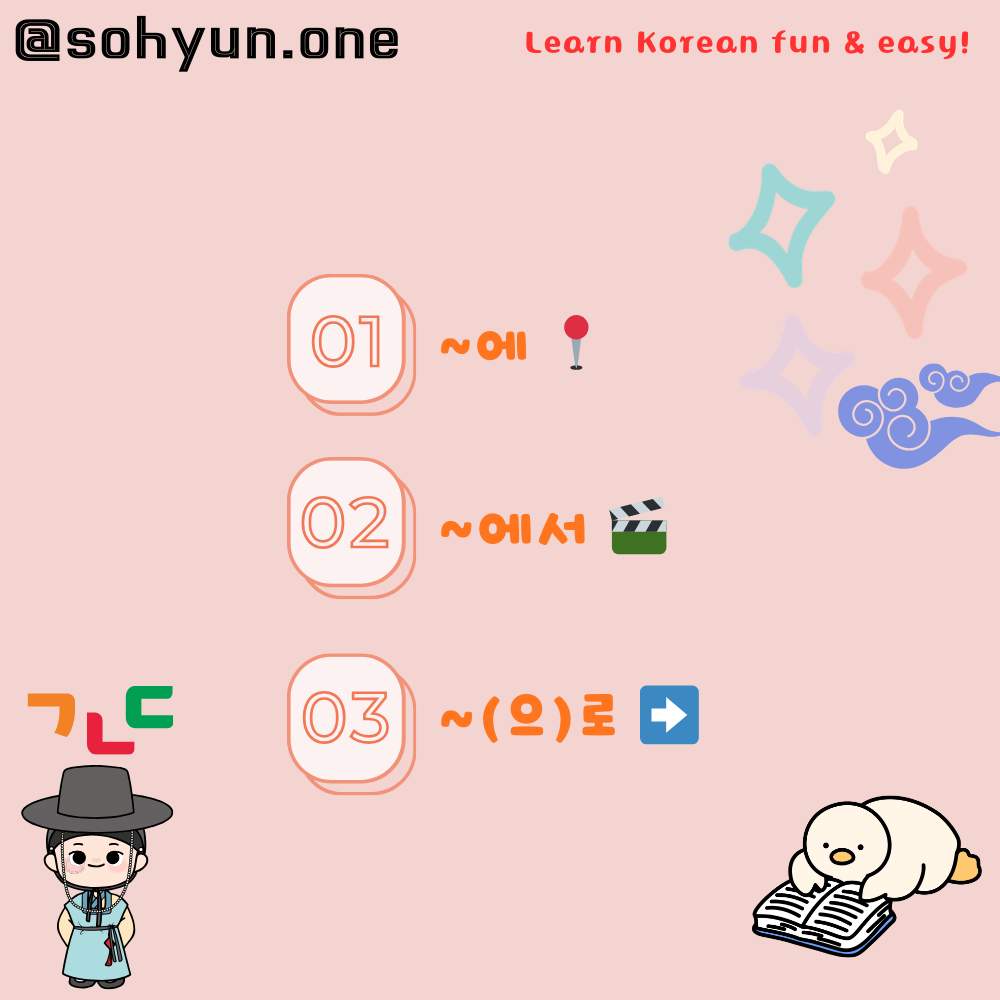
The differences between of 에, 에서 and (으)로
⭐ 1. “에” — location or destination (at / in / to)
This particle mainly expresses existence at a place or arrival at a destination.
Think of it as a point — like marking a dot on a map.
✔ Basic meaning
Where something is located
Where someone goes (arrival)
⚠ It does not describe the action happening inside the place.
👉 Rough English equivalents: at, in, to
✔ Korean examples
새가 나무 위에 있어요.
→ The bird is on the tree.
☑ 저는 서울에 살아요.
→ I live in Seoul.
★Just one exception: The verb살다 can be used with 에/에서 both. (When the nuance highlights WHERE to live, “에서” used more for it.)
저는 오늘 미용실에 갔어요.
→ I went to the hair salon today.
저는 집에 방금 도착했어요.
→ I just arrived at home.
고아원에 책을 기부를 했어요.
→ I donated books to the orphanage.
👉 Learners can imagine:
“에 = being there or reaching there.”
⭐ 2. “에서” — place where an action happens (at / in)
This particle indicates the stage or background where an action takes place.
Imagine a movie stage where the activity is performed.
✔ Usage rules
Used with action verbs.
Not used with pure movement verbs such as go, come, leave.
👉 Rough English equivalents: at, in depending on context.
👉 Easy idea:
“에서 = where something is happening.”
✔ Korean examples
저는 집에서 일해요.
→ I work from home.
저는 수영장에서 수영했어요
→ I swam in the pool today.
☑ 그 C.E.O.는 비버리힐즈에서 살아요.
→ The C.E.O. lives in Beverly Hills.
▶ There's a nuance that slightly emphasizes where the C.E.O. lives is "Beverly Hills."
그 C.E.O.가 사는 곳이 “비버리힐즈”임을 강조하는 뉘앙스가 있음.
카페에서 두쫀쿠를 먹었어요.
→ I ate Dubai chewy cookies in the cafe.
공연장에서 하루종일 남편과 남동생이랑 연습했어요.
→ I practiced at the concert hall with my husband and my younger brother all day.
창가에서 책을 읽어요.
→ I read books by the window.
⚠ Important contrast:
카페에 갔어요 (I went to a cafe → destination)
카페에서 공부했어요 (I worked at a cafe → action location)
⭐ 3. “(으)로” — direction, route, or means (toward / by / via)
This particle expresses movement direction or method.
Think of it as an arrow showing a path.
✔ Direction (toward)
Used when moving toward a place.
Similar to English toward or sometimes to.
👉The rule:
The noun ending in Vowel + 로
The noun ending in Consonant + 으로
✔ Korean examples
3시까지 회의실로 가야 해요.
→ I have to go toward the meeting room by 3pm.
1년 뒤에 한국으로 돌아가요.
→ I'm gonna go back to Korea in a year.
내일 LA로 출발해요.
→ I depart toward LA, tomorrow.
강아지가 정원으로 뛰어 갔어요.
→ The puppy ran to the garden.
고양이가 위로 점프했어요.
→ The cat jumped (toward) up.
👉 “(으)로 = route or road”
✔ Means or method (by / with / via)
Used to express how something is done.
English equivalents can be:
by bus
in Korean
by hand
via email
✔ Korean examples
약속 장소에 택시로 갔어요.
→ I went to the appointment place by taxi.
같이 한국어로 말해요.
→ Let’s speak in Korean.
오늘 점심은 토마토로 만들었어요.
→ As for today’s lunch, I cooked it with tomatoes.
파일을 왓츠앱으로 보내 주세요.
→ Please send the file via Whatsapp.
운동으로 하루를 시작해요.
→ I start a day with exercising.
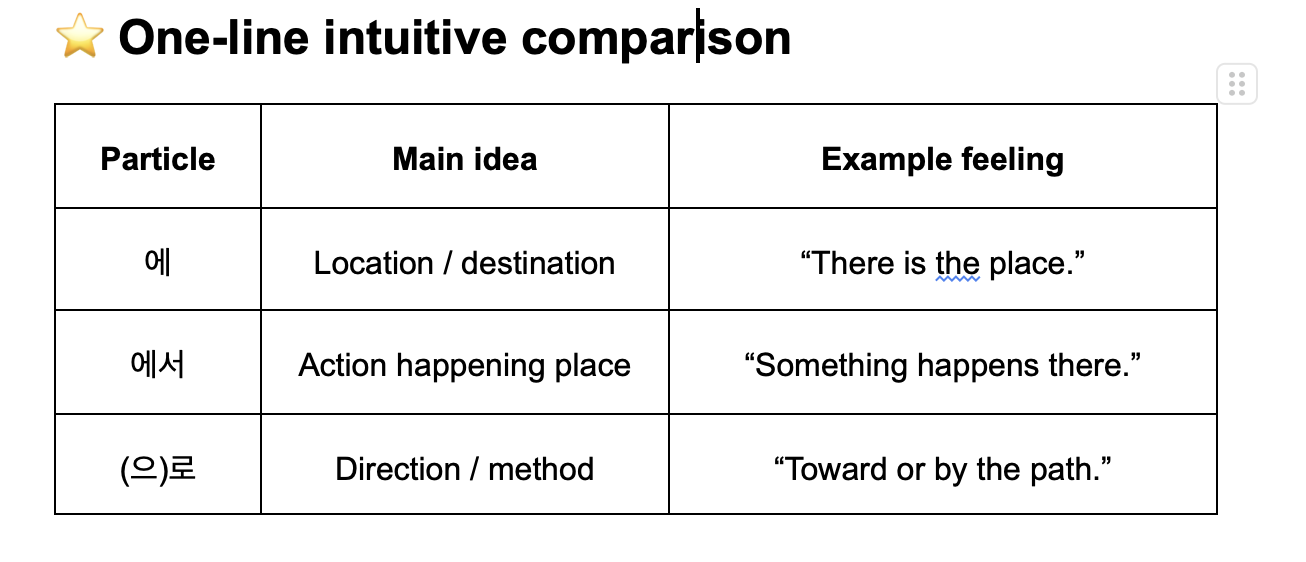
⭐ Super simple learner memory trick
에 → “I am there. / I go (toward) there.”
에서 → “I do something ”there”.”
(으)로 → “I move toward or use something.”
☑ Just one exception : the verb 살다 can be used with 에, 에서 both!
