
Feel & Sense
Let’s learn about expressions about “Feel & Sense” in Korean !
1️⃣ 느낌 (neukkim) — “feeling / vibe / impression”
느낌 comes from the verb 느끼다 = “to feel.”
It refers to:
Internal feelings
Impressions
Vibes
A general “sense” about something
👉 It’s not usually a physical sense like taste or touch. It’s more emotional or intuitive.
Example:
이 노래 느낌 좋다.
→ “This song has a good vibe.”
(Not “good feeling” literally — more like the vibe is nice.)
🔎 But in daily life…
Korean doesn’t always say “I feel cold/sad/bored” using 느낌.
Instead, Koreans usually just use descriptive adjectives directly:
추워요 = I’m cold.
슬퍼요 = I’m sad.
심심해요 = I’m bored.
Saying:
❌ 추위를 느껴요
sounds a bit dramatic — like you’re narrating a documentary about your own life.
When you DO use 느끼다
You use 느끼다 when you’re talking about experiencing something more abstract or reflective:
추위를 느껴요 = I feel the cold.
슬픔을 느꼈어요 = I felt sadness.
This sounds:
More literary
More emotional
More thoughtful
It’s like the difference between:
“I’m sad.”
vs“I felt a deep sense of sadness.”
2️⃣ 감 (感) — the “-ness” or emotional state builder
감 is a Sino-Korean root that builds abstract emotional nouns.
Think of it like an emotional LEGO block 🧱
Examples:
자신감 = self-confidence
죄책감 = guilt
성취감 = sense of achievement
It turns ideas into emotional states.
Important:
You can sometimes replace 느낌 with 감,
but you cannot use 감 as a verb like 느끼다.
You say:
자신감을 느꼈어요.
→ I felt confidence.
NOT:
❌ 자신감을 감했어요.
감 creates the emotion-noun.
느끼다 is what you do with it.
3️⃣ 각 (覺) / 감각 (感覺) — “sense / sensory awareness”
This is more physical or perceptual.
Think biology class 👀👂👃👅✋
미각 = taste
시각 = sight
촉각 = touch
청각 = hearing
후각 = smell
감각 = sense (general sensory ability)
This is about your sensory system, not your emotional vibe.
What about the verb 감각하다?
Technically it exists in the dictionary, but almost nobody uses it in daily speech.
Instead, Koreans say:
감각이 있다 = to have good sense (at style/art/timing/cooking)
감각이 없다 = to have no sense
Example:
그 코디네이터는 패션 감각이 없어요.
→ “The coordinator has no fashion sense.”
This is closer to “aesthetic sense” or “instinct.”
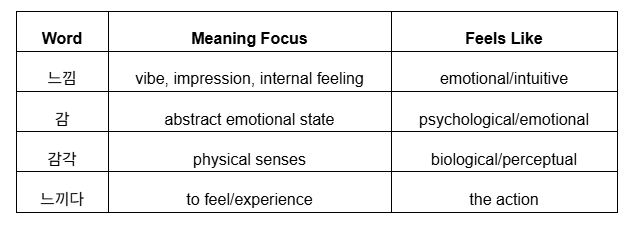
🔥 Quick Comparison Table
🎯 Simple Way to Remember
느낌 = vibe
감 = emotional state
감각 = sensory system
느끼다 = to feel or experience something internally
