
Korean Word Nominalization
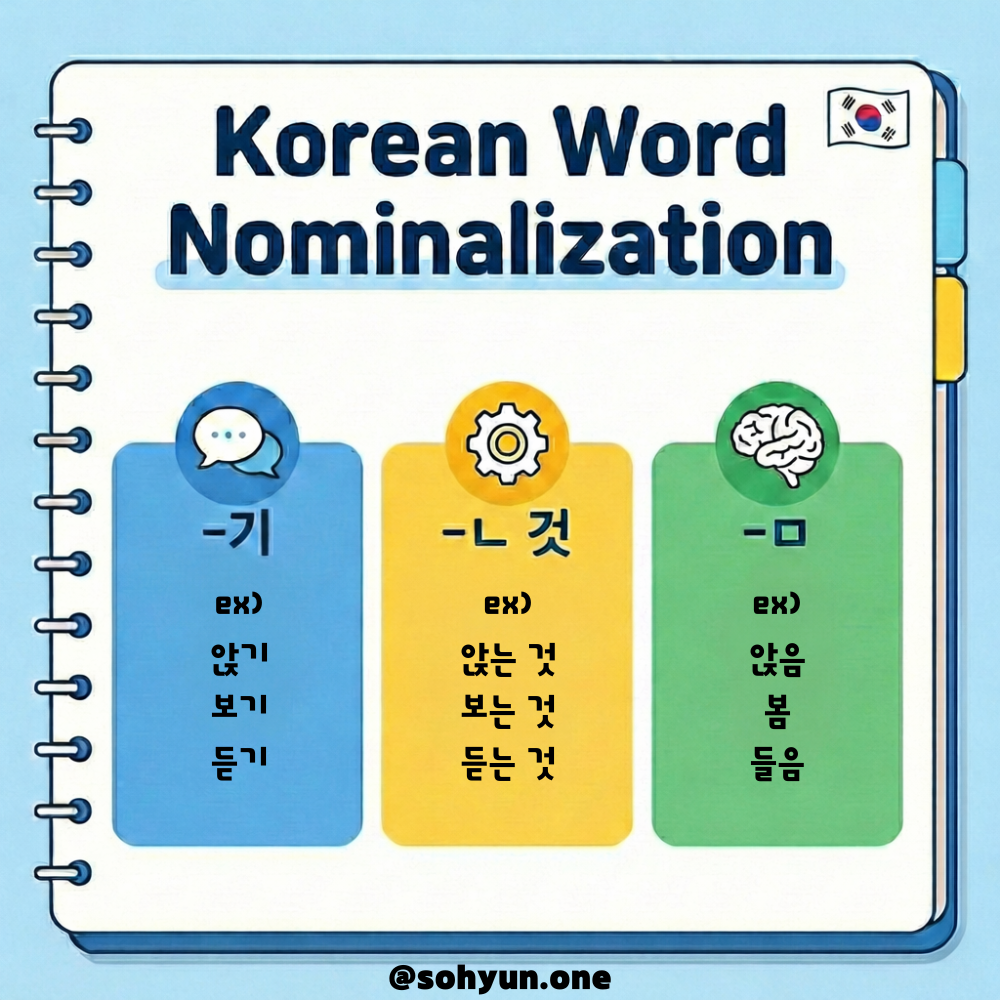
Let’s learn Korean word nominalization
# Korean Nominalization: –기, –(으/느)ㄴ 것, –(으)ㅁ
In Korean, you can turn a verb or adjective into a noun (or noun clause) in three main ways:
* –기
* –(으/느)ㄴ 것
* –(으)ㅁ
There is no perfectly strict grammar rule that separates them.
The best way to master them is through exposure to many examples.
However, each form does have a **general tendency and feeling**.
1. –기
: Unfinished action, general activity, emotions, habits, potential
**–기** focuses on the **action itself**, often something not yet completed or something discussed generally.
It is commonly used with:
* Emotion-related adjectives: 좋다, 싫다, 어렵다, 힘들다, 무섭다, etc.
* Verbs like: 바라다, 희망하다, 시작하다, 좋아하다, 싫어하다
###Examples
• 이 의자는 오래 앉기에 편해요.
→ This chair is comfortable to sit on for a long time.
• 혼자 여행하기 무서워요.
→ I’m scared of traveling alone.
• 한국어 발음 배우기가 생각보다 어려워요.
→ Learning Korean pronunciation is harder than expected.
• 숙제를 다 하기가 힘들어요.
→ It’s hard to finish homeworks.
• 아이들은 놀기를 정말 좋아해요.
→ Children really like playing.
• 부모님을 실망시키기 싫어요.
→ I don’t want to disappoint my parents.
• 올해 안에 취업하기를 바랍니다.
→ I hope to get a job within this year.
### Summary feeling
–기 = “the act of doing something” (unfinished, general, emotional target)
It is also used in idioms:
* 식은 죽 먹기 → Piece of cake
* 하늘의 별 따기 → Almost impossible
2. –(으)ㅁ
: Finished action, realized fact, judgment, report
**–(으)ㅁ** sounds more **factual and formal**.
It is often used when the speaker treats the information as an **established fact**, such as:
* Realization
* Judgment
* Reports
* Announcements
* News
* Official documents
You can attach past tense before –음:
갔음을, 끝났음을, 알았음을
### Examples
• 그가 이미 출발했음을 알았다.
→ I knew that he had already left.
• 이 문제가 생각보다 심각함을 깨달았다.
→ I realized that this problem is more serious than I thought.
• 그 배우가 결혼했음이 공식 발표되었다.
→ It was officially announced that the actor got married.
• 그 선수가 규칙을 어겼음이 밝혀졌다.
→ It was revealed that the player broke the rules.
• 그 제품이 위험함이 증명되었다.
→ It was proven that the product is dangerous.
### Common in written/formal style
You often see –음 in:
* News headlines
* Reports
* Official documents
Examples:
* 도로가 통제되었음.
→ The road has been closed.
* 시험 일정 변경됨.
→ Exam schedule changed.
### Summary feeling
–(으)ㅁ = “confirmed fact / formal statement”
3. –(으/느)ㄴ 것
: Most neutral and flexible form
**–(으/느)ㄴ 것** is the most commonly used form in daily conversation.
It is neutral and flexible, and in many cases can replace both –기 and –(으)ㅁ.
### Examples
• 요리하는 것이 재미있어요.
→ Cooking is fun.
• 새로운 사람을 만나는 것이 좋아요.
→ I like meeting new people.
• 그가 약속을 어긴 것을 알고 있었다.
→ I knew that he broke the promise.
• 네가 노력하고 있는 것을 알아.
→ I know that you are trying.
• 무서운 것은 싫어요.
→ I hate scary things.
### Comparison
• 집에 혼자 있는 것이 싫어요.
= 집에 혼자 있기 싫어요.
→ I don’t like being home alone.
• 그가 거짓말하고 있는 것이 분명해요.
= 그가 거짓말하고 있음이 분명해요.
→ It’s clear that he is lying.
• 지구의 온도가 4도 상승한 것으로 밝혀졌습니다.
= 지구의 온도가 4도 상승했음이 밝혀졌습니다.
→ It turned out that the Earth's temperature rose by 4 degrees Celsius.
### Summary feeling
–는 것 = safest, most natural choice in conversation
If learners are unsure which form to use, **using –는 것 is usually the best option**.
## Simple Comparison Chart
Form
Core feeling
–기
Action itself, unfinished, emotional
–(으)ㅁ
Confirmed fact, judgment, formal
–는 것
Neutral, conversational, Daily speech, flexible replacement
