롭다 vs 스럽다 vs 답다
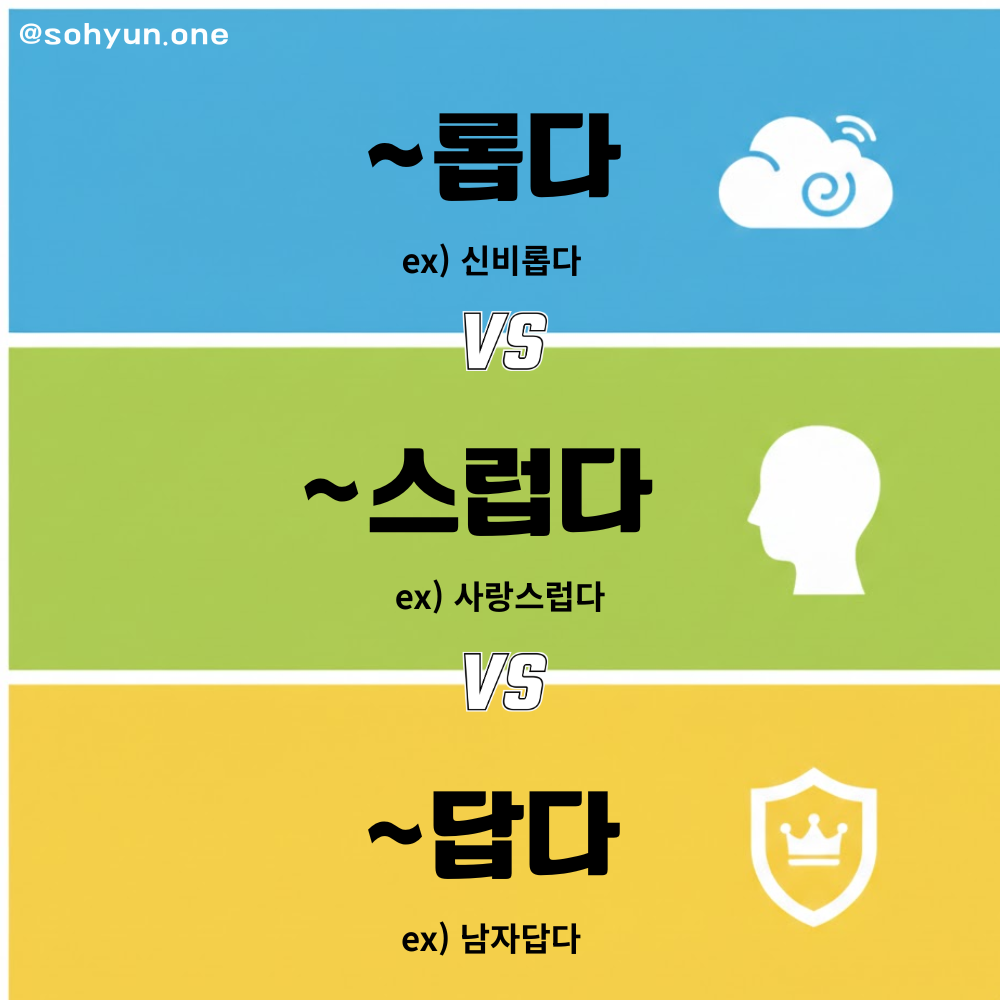
What are the differences between ~롭다, ~스럽다 and ~답다?
I would like to inform you that there is a difference like this overall, although it does not apply 100% to all expressions, so please make you exposured to real Korean conversations a lot such as TV show, movies or your favorite Genre’s Korean Youtube channel so on.
1. –롭다 (-ropda)
Meaning:
The quality is strong, inherent, or naturally abundant in the subject.
It describes a trait that feels deeply embedded, not just on the surface.
Examples
신비롭다 → mysterious (mystery feels deeply present)
외롭다 → lonely (loneliness is strongly felt)
자유롭다 → free
평화롭다 → peaceful
Sentence
우주는 항상 신비로워요.
The Universe is mysterious always. (The universe genuinely gives off a strong mysterious aura.)
2. –스럽다 (-seureopda)
Meaning:
It seems like the subject has that quality, or it gives that impression or feeling.
More subjective and based on perception.
Examples
신비스럽다 → seems mysterious
사랑스럽다 → lovable (gives a lovely feeling)
자연스럽다 → natural (feels natural)
부담스럽다 → feels burdensome
Sentence
뉴진스의 최신 앨범 노래는 신비스러워요.
The song of New Jeans’ latest album sounds mysterious. (It’s more about the impression he gives.)
3. –답다 (-dapda)
Meaning:
The subject is befitting of a role, identity, or standard.
It evaluates whether someone/something matches what is expected.
Examples
남자답다 → manly (fits what is expected of a man)
어른답다 → adult-like (behavior-wise, thoughts-wise)
학생답다 → like a proper student
정치인답다 → like a politician
Sentence
요즘 정치인다운 정치인들이 별로 없어요.
There are not many politicians who are like politicians these days..
Natural contrast with your example
Korean
Natural English nuance
우주는 신비로워요.
The universe is mysterious (strong, inherent aura).
노래가 신비스러워요.
The song sounds mysterious (based on impression).
정치인다운 정치인이 없어요.
There is no politicians who are like politicians.
Simple one-line summary (great for learners)
–롭다 = the quality is really there
–스럽다 = the quality is felt / seems to be there
–답다 = the quality matches what it should be
