이/가 vs 은/는
How are they different “이/가 and 은/는”?
Before starting the explanation, I declare that, to be honest, it’s difficult to fully understand the difference between **은/는** and **이/가** through grammar explanations alone. You really need to *use* Korean a lot in real life — speaking, reading, and listening — to grasp their nuance clearly. So try to expose yourself to plenty of real Korean—everyday conversations, shows, and other content—to naturally pick up how they’re used.
Then, here are the concepts of 이/가 and 은/는!
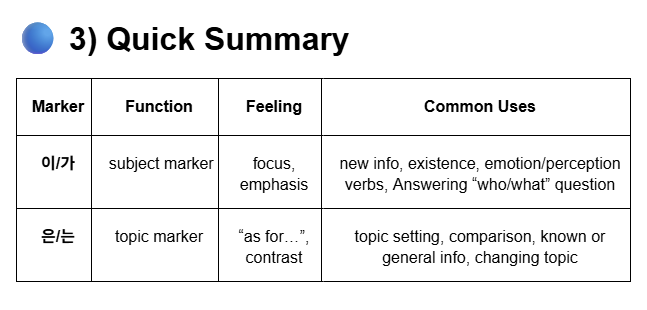
🔵 1) 이/가 — Subject Marker
Core Meaning
“이/가” marks the exact subject of the sentence.
It tells us who or what is performing the action or who/what is being described.
When It’s Used
Introducing new information
When something appears in the conversation for the first time.
Focusing on the subject
When the speaker wants to emphasize which person/thing is involved.
With emotion, perception, and existence verbs
verbs like “to be (exist),” “to appear,” “to be seen,” “to like,” “to dislike,” etc. ( the Korean expressions such as 있다/없다, 나타나다, 보이다, 좋다, 싫다 so on )
Answering “who/what” questions
Because it marks the specific subject.
Natural Feeling
Similar to highlighting or pointing:
“THIS (person/thing) is the one that…”
Examples
한국의 대표적인 명절로 설날이 있습니다.
→ There is Seollal, which is a Korean representative holiday. (introducing new info)이 집 칼국수가 정말 맛있어요.
→ The Kalguksu of this restaurant is really delicious. (subject focus)저는 고수가 싫어요.
→ I dislike coriander. (perception focus)누가 회의에 올 거예요? / 제이슨이 회의에 올 거예요.
→ Who will come to the meeting? / Jason is going to come to the meeting. (Answering “who/what” question)
🔵 2) 은/는 — Topic Marker
Core Meaning
“은/는” marks the topic of the sentence — what the sentence is about.
It sets the context or theme for what follows.
When It’s Used
Topic introduction
“As for ___,” “Speaking of ___.”
Contrast or comparison
A vs. B, differences, opposites.
General statements or known information
Background, general truths, facts.
Changing topics
When shifting the conversation direction.
Natural Feeling
Similar to saying:
“As for…” / “Regarding…”
Examples
이 카페는 라떼가 맛있어요.
→ As for this cafe, Latte is delicious. (topic introduction)사과는 좋아하지만 바나나는 싫어요.
→ I like apples, but bananas? I don’t. (contrast)서울은 겨울에 너무 추워요.
→ Seoul is so cold in winter. (general fact)지금까지 한국 음식에 대해 알아보았습니다. 다음은 한국 대중 문화에 대한 이야기입니다.
→ So far, we have learned about Korean foods. The following is the story of Korean pop culture. (changing topic)