
안 vs 못

How are they different “안 and 못”?
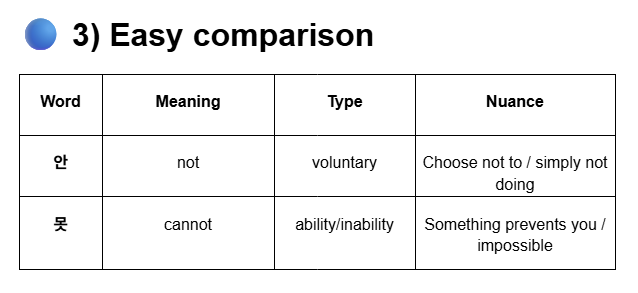
🔵 1) 안 — “not” (voluntary negation)
Meaning:
“안” is used when someone chooses not to do something or decides not to.
It expresses intentional, voluntary, or general negation.
Think: “I don’t / I won’t / I’m not doing it (by choice).”
Examples:
마이크는 절에 안 가요. = Mike is not going to a temple. (SUB choose not to)
저는 고수를 안 먹어요. = I don’t eat coriander. (maybe because I don't like it)
숙제를 안 했어요. = I didn’t do my homework. (I didn’t do it—not necessarily impossible)
🔵 2) 못 — “cannot” (inability / impossibility)
Meaning:
“못” expresses inability, lack of capability, external circumstances, or something preventing the action.
The nuance is: “I can’t / I’m unable to / It was impossible.”
Think: “I can’t do it (because something stops me).”
Examples:
시력을 잃은 후, 저는 책을 못 읽어요. = I can't read a book after losing my sight. (I’m unable to)
저는 어제 점심을 못 먹었어요. = I couldn’t eat lunch yesterday. (maybe I was sick or had no time)
저는 오늘 요가 학원에 못 가요. = I can’t go to the Yoga studio today. (because something prevented me)
🔵 4) Same verb, different meaning
✔ 안 가요 = I’m not going.
(Decision / choice)
✔ 못 가요 = I can’t go.
(I’m unable to — busy, sick, no transportation, etc.)
✔ 안 먹었어요 = I didn’t eat.
(I chose not to eat.)
✔ 못 먹었어요 = I couldn’t eat.
(I was sick / had no time / no food available.)
