
How to apply ~데 depending on verb / adjective / NOUN so on
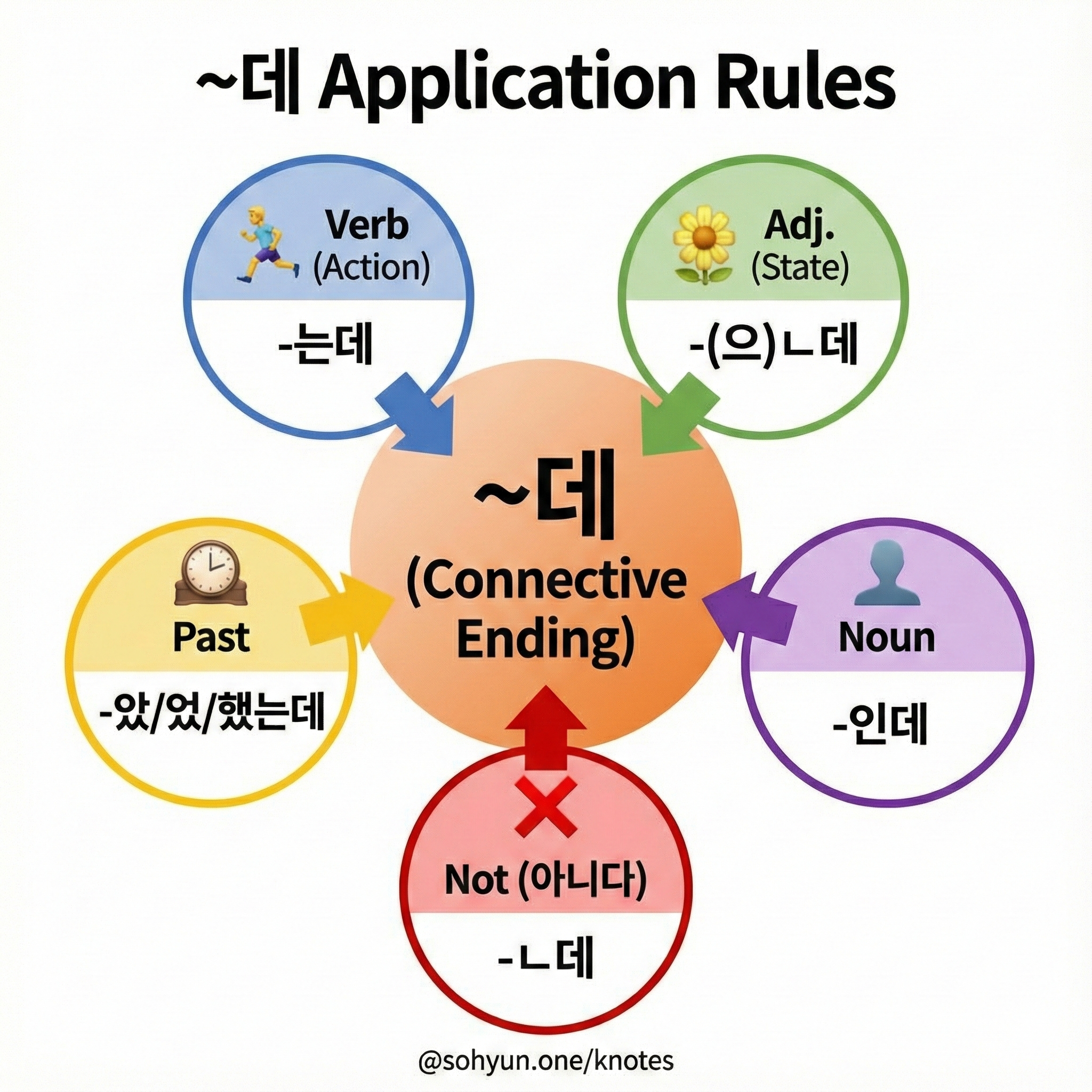
How to apply ~데 depending on verb / adjective / NOUN so on
1️⃣ –는데 (verb / 있다·없다)
When to use
Action verbs (하다, 가다, 먹다, 오다 등)
있다 / 없다
Progressive or general actions
Grammar logic
Verbs take –는 in present descriptive clauses → –는데
Examples
지금 비가 오는데 우산 있어요?
→ It’s raining right now, so / given that, do you have an umbrella?저는 회사에 가는데 시간이 좀 걸려요.
→ I go to work, and it takes some time.지금 현금이 없는데 어떻게 해야 할까요?
→ I don’t have cash now, so what should I do?아이가 자고 있는데 너무 조용해요.
→ The child is sleeping, so it’s very quiet.
English explanation
Used when the preceding clause describes an action or ongoing state,
providing background or contrast.
l Exception) When the verb stem ending is ㄹ, drop ㄹ and add 는데.
❌ 돈은 많이 벌은데 시간이 없어요.
돈은 많이 버는데 시간이 없어요. (I make a lot of money, but time.)
2️⃣ –은데 / –ㄴ데 (adjectives)
When to use
Descriptive adjectives (춥다, 비싸다, 예쁘다, 어렵다 등)
Choice depends on 받침 (final consonant)
Form rule
받침 있으면 (If there is Batchim) → –은데
ㄹ 받침 있으면 (If there is ㄹ Batchim) → Drop ㄹ and –ㄴ데
ㅂ 받침 있으면 (If there is ㅂ Batchim) → Drop ㅂ and 운데
받침 없으면 (If there is no Batchim) → –ㄴ데
Examples
오늘 날씨가 추운데 바람도 불어요.
→ It’s cold today, and it’s also windy.이 가방이 비싼데 너무 예뻐요.
→ This bag is expensive, but it’s very pretty.가을이는 귀여운데 똑똑해요.
→ Ga-eul is cute, and (even) smart.이 문제는 어려운데 설명해 줄게요.
→ This quiz is difficult, so I’ll explain it.리사는 다리가 긴데 얼굴은 작아요.
→ Lisa has long legs, but her face is small.
English explanation
Adjectives describe states or qualities,
so they take –은/–ㄴ before –데, not –는.
3️⃣ Past reference: –았/었/했는데
When to use
Talking about a past situation as background
Applies to both verbs and adjectives
Examples
어제는 비가 왔는데 오늘은 맑아요.
→ It rained yesterday, but today it’s sunny.그 영화 재미있었는데 끝이 좀 아쉬웠어요.
→ The movie was fun, but the ending was a bit disappointing.예전에 여기 살았는데 다른 동네에 살아요.
→ I used to live here, but I live in a different neighborhood.
English explanation
The past marker –았/었/했– comes before –는데,
because –데 connects clauses, not tense.
4️⃣ Special note: 아니다 → –ㄴ데
아니다 ( am not / is not / are not ) is applied like an adjective with -ㄴ데
Example
그건 제 잘못이 아닌데요.
→ That’s not my fault, though.그 여자들은 한국 사람이 아닌데 한국말을 잘 해요.
→ Those women are not Koreans, but they speak Korean so well.
5️⃣ 명사 + 인데
When to use
The preceding clause ends in a noun
You want to give background, contrast, explanation, or conversation starter so on.
Very common in spoken Korean
Grammar logic
Nouns cannot take –는 or –은/–ㄴ directly.
So Korean uses “Noun + (이)다 + –ㄴ데 -> NOUN인데”
Examples (background / explanation)
오늘 평일인데 회사에 사람이 없어요.
→ It’s a weekday today, and there aren’t many people at the office.지금 점심시간인데 식당 앞에 줄이 길어요.
→ It’s lunchtime, and there is a long waiting line in front of the restaurant.저 사람은 댄서인데 왜 그렇게 춤을 못 춰요?
→ That person is a dancer, but why is he that bad at dancing?
Examples (contrast)
그 사람은 학생인데 회사를 운영해요.
→ He’s a student, and he runs a company.겨울인데 눈이 많이 안 내려요.
→ It’s winter, but it doesn’t snow that much.
Examples (soft lead-in / conversation starter)
Very common in natural speech:
이게 Wi-fi QR 코드인데 스캔해 보세요.
→ This is the Wi-fi QR code, so please scan it.제가 좋아하는 노래인데 같이 들을래요?
→ This is a song I like, so would you like to listen to it together?
🚫 Common learner mistakes
❌ 오늘 덥은데 패딩을 입었어요.
✔ 오늘 더운데 옷을 많이 입었어요
→ It’s hot today, but I wore a padded jacket.
❌ 고양이가 울는데 아이가 우는 것 같아요.
✔ 고양이가 우는데 아이가 우는 것 같아요.
→ A cat is crying, and it sounds like a baby is crying.
❌ 줄이 길은데 그냥 기다리고 있어요
✔ 줄이 긴데 그냥 기다리고 있어요
→ The waiting line is long, but we just are waiting in a line.
❌ 이 옷은 너무 귀엽은데 비싸요.
✔ 이 옷은 너무 귀여운데 비싸요.
→ This cloth is so cute, but it’s expensive.
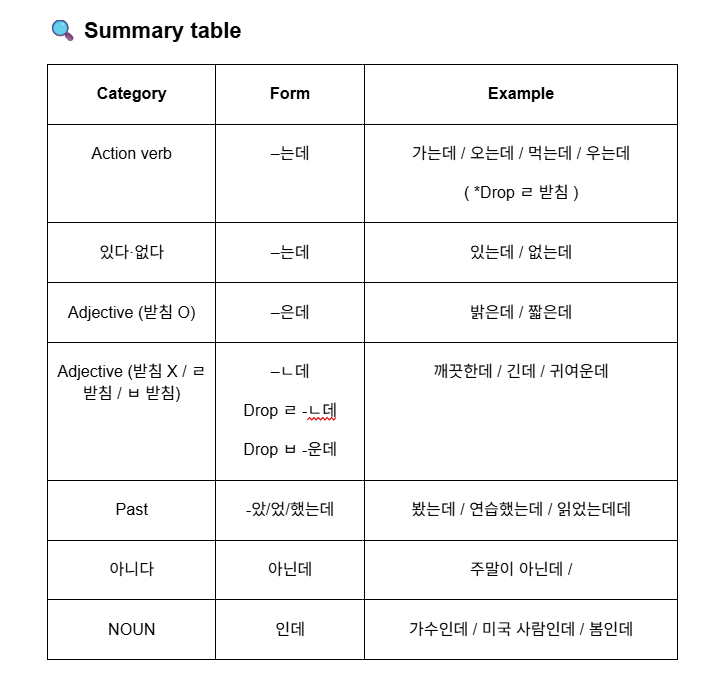
🎯 One-line memory rule
Action → –는데
Adjective Description → –은/–ㄴ데
Past → –았/었/했는데
아니다 → 아닌데
NOUN → 인데
