
The differences of 데, 대 and 때
The differences of 데, 대 and 때
1️⃣ –데
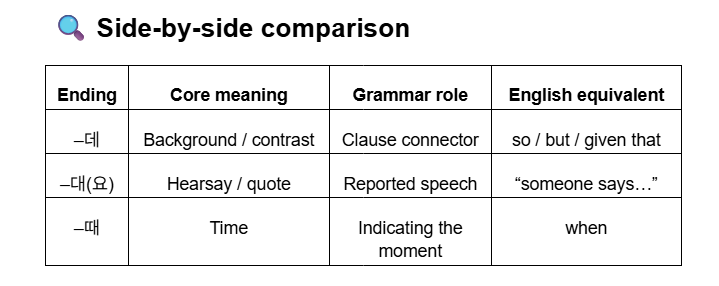
Function: background, contrast, soft connection
–데(요) is not a standalone tense or quote.
It provides background information, sets a context, or shows contrast, often implying “so / but / and then”.
Grammatically, –데 almost always appears as –는데 / –은데 / –ㄴ데 depending on the verb/adjective.
Key idea
“Here’s some context… (and based on that…)”
Examples
오늘 추운데 인사동에서 야외 공연을 했어요.
→ It’s cold (background), but we did the outdoor performance in Insa-dong.이 카페는 예쁜데 커피가 비싸요.
→ The cafe is pretty but the coffee is expensive.비가 오는데 우산 있어요?
→ It’s raining (given that), do you have an umbrella?지금 마트에 가는데, 뭐 좀 사다 드릴까요?.
→ I’m going to go to a mart now, so would you like me to get you something?
Learner tip
❌ –데 does NOT mean “when”
❌ –데 does NOT quote anyone
✔ Think of it as context + implication
2️⃣ –대(요)
Function: hearsay / quoting what someone said
–대(요) comes from –다고 해요.
It is used when you’re reporting information you heard from someone else.
Key idea
“This is what I heard someone say.”
Examples
친구가 오늘 춥대요.
→ My friend says it’s cold, today.크리스마스에 눈이 온대요.
→ I heard it will snows in Christmas.그 식당 맛있대요.
→ People say that restaurant is good.의사 선생님이 쉬어야 한대요.
→ The doctor said I need to rest.
Learner tip
✔ Always involves someone else’s words or information
✔ Often used in casual spoken Korean
❌ Not used for your own direct feelings
3️⃣ –때
Function: time (“when”)
–때 is a noun meaning “time”.
It attaches to verbs/adjectives to mean “when / at the time that”.
Key idea
“At the time when…”
Examples
추울 때 패딩을 입어요.
→ When it’s cold, I wear a padded jacket.한국에 처음 왔을 때 많이 힘들었어요.
→ When I first came to Korea, it was very hard.아플 때 병원에 가세요.
→ Go to see a doctor when you’re not feeling well.어릴 때 이 동네에 살았어요.
→ I lived in this neighborhood when I was young.
Learner tip
✔ Can be replaced by “when” in English
✔ Often followed by 에 ( ~ 때에)
❌ No implication, no hearsay -> just time
🚫 Common learner mistakes
❌ 오늘 추울 대 목도리를 안 가져왔어요
✔ 오늘 추운데 목도리를 안 가져왔어요
❌ 친구가 아플 데 같이 병원에 갔어요
✔ 친구가 아플 때 같이 병원에 갔어요
🎯 One-sentence memory trick
데 → “Here’s the situation…”
대 → “I heard that…”, “Someone said…”
때 → “When…”
